

Outpatient surgery | Outpatient surgical care in Berlin-Frohnau
The advantages of outpatient surgeryNowadays, many operations no longer require an inpatient stay. Outpatient surgery offers numerous advantages for patients: Relationship based on trust and individual careYour doctor, who already knows and is treating you, will perform the procedure and also take care of the aftercare. This means that you receive individually tailored care – all from a single source. Experienced specialists and modern standardsOutpatient procedures are performed by experienced specialists. Modern hospital standards and gentle anesthesia guarantee maximum safety, regardless of the patient's age. Fast recovery at homeAfter surgery, you will benefit from a faster recovery with fewer complications in your familiar surroundings. This reduces psychological stress, especially for children and the elderly, as there is no need to stay in an unfamiliar environment. Cost efficiencyOutpatient surgery is more cost-effective than inpatient surgery and makes an important contribution to relieving the burden on the healthcare system. Highest safety standardsOutpatient surgeries are carried out under strict safety conditions, which are guaranteed by legal regulations and quality guidelines of the German Agency for Quality in Medicine (ÄZQ) and the German Association for Outpatient Surgery (BAO). |
 ConclusionOutpatient surgery is a modern and efficient alternative to inpatient surgery. It combines medical safety with personal comfort and helps to relieve the burden on both the patient and the healthcare system. All outpatient surgeries are performed at the OP-Zentrum Berlin Reinickendorf: |

Hand operations | Hand surgery Berlin-Frohnau
The hand | Focus on precision and functionOne focus of outpatient surgery is hand surgery. The procedures are usually performed on an outpatient basis and, if possible, under local anesthesia or regional anesthesia. Common complaints and their surgical treatment:Carpal tunnel syndrome:Symptoms: Numbness in the fingers, especially at night, as well as limited fine motor skills and loss of strength. Cause: Constriction of the median nerve in the area of the carpal tunnel. Therapy: Surgical splitting of the ligament above it to relieve pressure on the nerve. The typical symptoms should disappear after the operation. Trigger finger:Symptoms: When bending, a finger can no longer be stretched. Pain and restricted movement occur because the tendon gets stuck in the tendon sheath. Treatment: Surgical splitting of the tendon sheath to restore mobility. Dupuytren's contractureSymptoms: Hardening of the tendon plate causes the fingers (usually the 4th and 5th) to retract into the palm of the hand. Therapy: In advanced stages, an operation can help to maintain mobility. However, it is not advisable to operate too early on only slight nodules. |
Ganglia (lumps):Symptoms: Swelling on the back of the hand, wrist or in the flexor tendon sheaths. These occur when the joint capsule, which is filled with synovial fluid, is weak. Therapy: Surgical removal if there is pressure on surrounding tissue or functional limitations. Tendon tears:Symptoms: Functional impairment due to torn tendons in the hand or fingers. Therapy: Surgical treatment to restore hand function. |

Should you have any further questions or want to make an appointment: Call us at 030 40 60 79 01, or send an email.
Foot Surgery | Modern treatment approaches for pain-free mobility
The foot | An area that is frequently affectedStatistics show that around 50% of the adult population in Central Europe suffer from pain or deformities in the area of the forefoot and toes. The most common changes include:
Non-surgical measures:In many cases, conservative measures can alleviate complaints:
Surgical procedures | When conservative measures are insufficientIf conservative treatments are ineffective in the long term, surgery may be necessary. Modern procedures today offer gentle and effective solutions that are tailored to the individual needs of patients. |
|

Should you have any further questions about foot surgery or want to make an appointment: Call us at 030 40 60 79 01, or send an email.
Ambulatory operations
Arthroscopic meniscus operationsA meniscus tear has been diagnosed on the basis of your description of your knee problems and clinical examinations i.e. performing certain provocative manual tests. The medial and lateral menisci are sickle-shaped discs of cartilage between the thigh and shin bones, which serve to absorb shock and stabilise the knee joint. In the case of injury, such as rotation during sport or due to joint degeneration in advanced age, a meniscus may tear and parts of it become deposited in the joint-space. The results is pain on moving and when putting weight on the knee, as well as mechanical damage to the joint cartilage. The aim of the arthroscopic meniscus operation is to remove all torn particles while preserving undamaged meniscus tissue. Only those parts are removed that inhibit the joint function, damage the joint surfaces or cause pain and inflammation. This is done using miniature instruments that have been especially developed for arthroscopic orthopaedics and surgical cutting instruments with a vacuum feature. In some cases it is possible to arthroscopically suture the meniscus, for example when the tear is very close to the capsule. Removal of the meniscus is then no longer necessary. Welcome side-effects of arthroscopic orthopaedics are the almost complete absence of pain following the operation, the lack of large scars and the possibility of carrying out ambulatory operations. As mentioned above, the main advantage of the arthroscopic technique over ‘cutting operations’ is that all intact parts of the meniscus can be left untouched. |
Arthroscopic resection of the meniscus therefore considerably reduces the risk of the occurrence of postoperative arthritis. The operation requires an incision no longer than 0.2 of an inch through which a camera, and any equipment that may be needed, is inserted into the joint. Irrigation fluid is pumped into the joint to distend the space between its surfaces and ensure a good view. Meniscus tears, for example, are sutured if possible and medically sensible, otherwise partially or entirely removed. |

Should you have any further questions or want to make an appointment: Call us at 030 - 44 35 193 0, or send an email.
Ambulatory operations
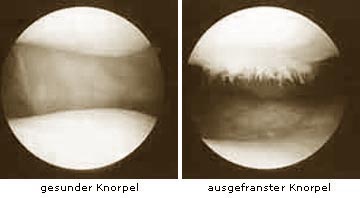
Arthroscopic operations for arthrosis and damaged cartilageCartilage damage can occur in the knee as a result of injury, overexertion or due to mechanical functions. Four stages can be differentiated:
Cartilage damage can occur on the cartilaginous joint surfaces of the thigh and shines through mechanical disturbance caused by an old meniscus tear. Minimal incarcerations of meniscus particles between the joint surfaces cause fraying, which can progress to complete abrasion of the cartilaginous surface. The prognosis, with regard to load-bearing capacity and freedom from symptoms following arthroscopic operation of a meniscus, depends on the damage caused to the cartilage by the injury. Frayed and shredded cartilage is smoothed using special arthroscopic cutting instruments with a vacuum function. All loose particles are sucked out of the joint. Depending on the extent of the findings, the patient needs elbow crutches to keep the weight off the leg for 1 – 4 weeks following the arthroscopic operation. If there is already complete abrasion of the joint cartilage, treatment involves freeing the bone from dead superficial tissue in order to trigger cartilage production. Using a surgical shaving instrument the bone is superficially shaved until the blood supply to the bone is visible. This is the only method that facilitates the development of new cartilage-like tissue from within the depth of the shaved bone in 3-6 months, and which is capable of taking over much of the function of the lost joint cartilage. In order to allow the covering layer to become as thick and durable as possible the patient has to use elbow crutches for approx. 6 weeks following the arthroscopic operation. This means that the operated knee only carries out walking movements without taking any weight. We will teach you how to walk using crutches and are sure that you will find it simple to learn. |
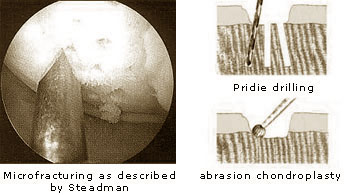
Production of replacement fibrocartilage (microfracture according to Steadman, subchondral abrasion, Pridie drilling):In the case of complete cartilage lesion of the subchondral bone the aim of the repair process is to provide fibrocartilage cover for the damaged chondral surface. Perforation of the hard bone layer causes blood and bone marrow cells to flow into the damaged cartilage. Some of the released cells are pluripotent i.e. undefined, and still able develop into specialist cells. The direction of their development is determined by the nature of the surrounding area. This means that in an area of damaged cartilage the cells receive information to become cartilage cells and then produce new, replacement fibrocartilage. The type of cartilage damage determines which process is applied.
|